Living in Austin, TX
Step into a city full of music, flavor and sunshine.
Why You’ll Love Living in Austin, TX
Austin, Texas, is one of the most popular places to relocate to, with warm weather and a growing economy. The capital city of Texas welcomes thousands of new residents each year, including young professionals, couples, families and retirees. It has a population of around one million people, with a median income over $95,000 a year and a median home value over $550,000.
It experienced a recent tech boom that is cooling off, making for a strong economy that is still evolving. Many people move here for work, or they come for the lower cost of living compared to other major US cities. With a friendly, fit community, it’s easy to feel at home here and find plenty of fun things to do, from Friday night concerts to Sunday morning strolls around the local lake. Discover why so many people are flocking to Austin, TX, and why it might be the right place for you.
“Keep Austin Weird” has been the slogan since 2000 and has come to define the city. While it might not be as weird and hipster as it once was, Austin continues to be an artistic and innovative place that offers locals a blend of music culture, great food, history and outdoor recreation. If you hate the cold and love a concert, it’s the perfect place for you.
Quick Facts About Austin, TX
- Average Commute
- 22 minutes
- Median Home Value
- $579,324
- Median Household Income
- $161,206
- Total Population
- 1,000,663
- Median Property Tax
- $2,090
- Median Monthly Rent
- $1,659
Where Is Austin, TX?
Austin is located in the southern region of Central Texas in what is known as the Texas Hill Country along the Colorado River. Most of the city is in Travis County, but some areas are part of Hays County or Williamson County. Austin is also positioned in the middle of three other major cities:
Nearby Major Cities
- Houston: This massive Texas city is about 160 miles east of Austin, about a 3-hour drive. It’s an excellent destination for museum lovers, parks and outdoor fun, and more.
- Dallas: Dallas is just a little farther, positioned 200 miles north of Austin, but takes around the same three hours to reach by car. This is another fabulous area if you want to explore green spaces, historical spots, museums, and the local BBQ scene.
- San Antonio: This city is about 80 miles southwest of Austin and takes about 1.5 hours to reach, making it a great getaway for Austin locals. People love the scenic river spots, the Alamo history, Mexican food, and charming culture.
For anyone curious about proximity to the ocean, Austin isn’t close to the water, but it’s not impossibly far away. It’s roughly 3–4 hours away from the nearest beach on the Gulf Coast, but the river runs right through the city and flows into several lakes, providing plenty of water recreation.
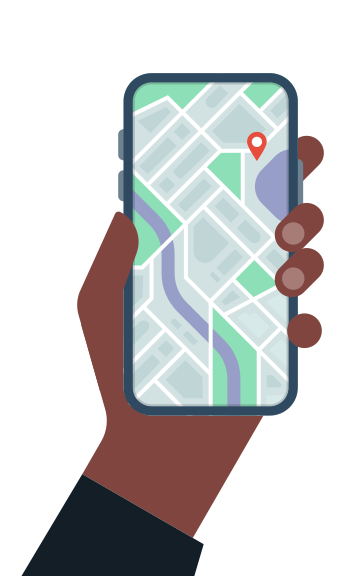
Map of Austin, TX
Where to Live in Austin, TX
Austin has a wide variety of neighborhoods, and there’s one for every type of person. Areas like Pemberton Heights and Tarrytown have a more historic and affluent vibe, with single-family homes that some families have owned for generations. Pemberton has a luxurious, traditional character, while Tarrytown is just as grand, but has a water-centric, relaxed lifestyle.
For those who want to live in an area teeming with young professionals, Zilker is a brilliant option, with an outdoorsy vibe and active community. It’s right near a range of outdoor destinations, including the 350-acre Zilker Metropolitan Park. But if you want a more indoorsy vibe, Hyde Park is a charming, bookish neighborhood with many college students. It offers excellent walkability and an academic atmosphere.
Those who are after exciting nightlife should check out Clarksville, a neighborhood with a more urban environment and plenty of restaurants and bars. It’s quite a hip place to live if you love being surrounded by good food and good vibes. Bouldin Creek also has a stellar nightlife scene, with a funky hipster atmosphere and genuine Austin energy.
While not technically in Austin city limits, West Lake Hills is a popular neighborhood among those who commute to Austin. This small suburb has bigger lots and multi-million dollar homes, along with gorgeous scenery. And it’s just a short drive from the buzzy excitement of the city.
Housing Profile and Market
The Austin housing market is fairly competitive, with the average home costing over $500,000. The cost of housing fluctuates, so strategic buying can help you get an excellent deal on a beautiful property. The house styles range from Texas Hill Country stone homes and ’20s Craftsman houses to mid-century modern ranch homes and contemporary urban builds.
Local Weather and Climate
Ask anyone who lives in Southern Texas, and they’ll tell you: The summers are intense. Many say the city has 3 summers and 1 winter, with hot weather starting in March and keeping things steamy until October. It’s worth mentioning that the city has no shortage of air conditioning, so if you’re inside, you’re probably fine.
The city frequently sees triple-digit temps in July and August, and the humidity can be quite high. It’s considered a subtropical climate, with summer highs around 100ºF and lows between 60ºF and 70ºF. Winter temperatures rarely drop below freezing, with highs in the mid-60s to low-70s and lows in the 40s and 50s. On average, it rains 4 days a month, and it almost never snows, making this ideal for people who love the heat.
Average Temperatures
79 high / 56 low
Average Annual Rainfall
35 in
Average Annual Snowfall
0 in
Things To Do: Food, Festivals and Outdoor Fun
Austin is overflowing with things to do, and the beauty of this city means even an aimless walk or drive around is delightful. There’s no denying the vibrant food scene, which includes everything from classic Texas BBQ to creative food trucks. You can indulge at an upscale farm-to-table restaurant or grab frozen margaritas at a casual Mexican spot.
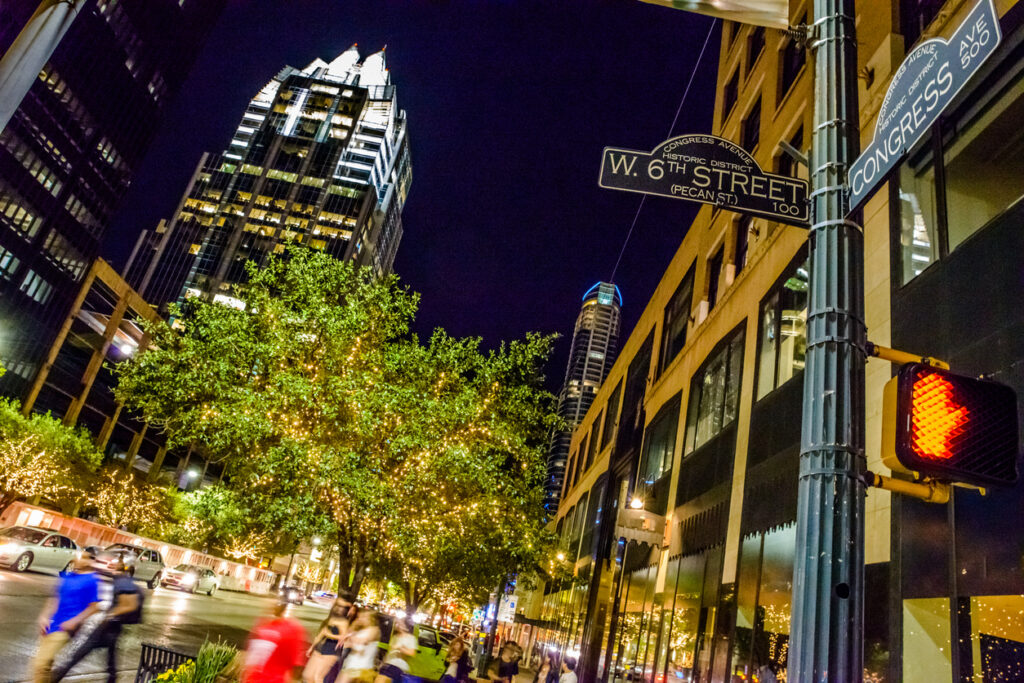
The city offers a lively nightlife, especially along Sixth Street, where there are small live music venues hosting upcoming and undiscovered artists. In fact, there’s live music throughout the city every weekend, and even on the weekdays in certain places. Plus, Austin hosts several music festivals, including the famous SXSW and Austin City Limits festivals.
For those who want to dive into the historic or architectural side of the city, you can visit the Texas Capitol or Bullock Texas State History Museum. Locals recommend checking out the Austin Central Library, which is surprisingly impressive for a library, with a modern design that boasts six floors and stunning natural light.
If you want to brace the Texas heat and enjoy outdoor activities, visit McKinney Falls State Park at sunset or walk through Zilker Botanical Garden. People also love to take a dip in the Barton Springs Pool or paddleboard or kayak around picturesque Lady Bird Lake. The city is also famous for being home to the Congress Avenue Bridge bats, which you can watch fly out at dusk during certain times of the year.
Economy: A Changing Landscape
The Austin economy is in a period of change. The city’s population is growing rapidly, with roughly 50,000 new residents each year. This can simultaneously strain the economy and bolster it. However, the area is known for its skilled workforce, small business success and innovative economic climate. Many major companies have set up headquarters in the city, including Apple, Tesla and Samsung, providing jobs for countless residents.
Once considered an extremely affordable area, the cost of living in Austin has increased because of the spike in business and ongoing construction throughout the city. Currently, the biggest industries are tech, manufacturing, healthcare, education and government work. One of the biggest draws of living in Austin (and Texas in general) is that there’s no state income tax, which frequently offsets any increase in cost of living for new residents.
Learning and Education in Austin, TX
Austin is and always has been a big college town. It’s definitely a big city, and its status as a college town has dwindled as the population expands and the area welcomes major players in the tech industry. But it still has a large student population, and certain areas have a distinct college atmosphere. Roughly 10% of the city’s population is made up of students, many of whom attend the University of Texas at Austin, St. Edward’s University, Huston-Tillotson University, or Austin Community College.
As far as primary public schools, the city is served by the Austin Independent School District, which is a highly diverse district with over 100 schools. The performance ratings are mixed, with schools in more affluent areas showing higher test scores. Surrounding districts, such as the Eanes ISD and Lake Travis ISD, tend to be higher performing. Many parents choose to send their children to local private schools, of which there are many, and they range widely in their mission, values, and political or religious beliefs.
Health Care in Austin, TX
Healthcare in Austin, TX is strong, with several major hospitals, specialized medical centers, and urgent care clinics. Some of the biggest hospitals include St. David’s Medical Center and the Dell Seton Medical Center at The University of Texas. Highly rated clinics, such as UT Health Austin, Central Health, and Baylor Scott & White Medical Center, also offer emergency services and excellent specialty care. Many note that there is a lack of reproductive and emergency maternal care due to state restrictions, but overall, the city provides locals with decent access to medical care and health facilities.
Quirks & Perks
While Austin has plenty to do and an inviting culture, there are a few aspects that might not be for everyone. Namely, it’s not a big sports city at all, with just one local soccer team. There are college sports teams to root for, but if days out at an MLB ball game or tailgating an NFL game are important to you, Austin could be a letdown.
What they lack in sporting events, they make up for in live music. The city is known as the Live Music Capital of the World, with dozens of iconic venues that come in all sizes and styles, ranging from moody jazz clubs to honky-tonk spots. The Moody Center is the city’s largest concert arena and often hosts major stars.
Some good news for dog people: Austin’s population is very into canines. It’s considered one of the most dog-friendly cities in the country, with pups and hounds out for walks in every neighborhood.
People might walk their dogs around, but it should be noted that you probably need a car if you want to live in this city. It doesn’t have the strongest public transportation system. You may be able to live without a vehicle if you spend all your time in Central Austin; otherwise, traveling around the area is difficult.
There’s also a strong health culture, with many locals prioritizing fitness. So if you love spending time at the gym, you won’t have any trouble finding one and connecting with folks who share your love of working out. Many consider it a city full of “fit” people.
Austin, TX Frequently Asked Questions (FAQ)
Many things are special about Austin, but the lively music scene is one of the most notable aspects of the city. It’s also famous for its quirky culture and hot summers.
Austin is considered a good place to move for work, as it ranks high in career growth and has several industries that are quickly expanding, including tech.
It depends on why someone visits or what they’re interested in, but the Texas State Capitol is among the most popular attractions.
Many consider the Barton Springs Pool a must-do, as well as indulging in authentic Texas BBQ.
Austin’s cost of living is slightly below the national average, but many say costs are rising. The cost of living for a single person is roughly $2,500 per month, and about $5,700 per month for a family of four.
It depends on what kind of atmosphere you prefer, but many consider areas like Pemberton Heights, Clarksville, Tarrytown, Zilker, Bouldin Creek and Hyde Park to be the top Austin neighborhoods.
For most of the year, it’s very humid and hot, between 75ºF and 100ºF, but the winters are pleasantly mild.
Yes! Millions of people visit Austin every year for the music scene, food scene, outdoor recreation and historic sites.
Yes, Austin is a popular choice among families due to affordability and decent safety ratings.
Austin is widely considered a college-centered city, with several respectable universities. The public school system receives mixed performance ratings.
Austin is about three hours from Dallas and Houston, and about 1.5 hours from San Antonio.
The Austin-Bergstrom International Airport is about 20 minutes south of Austin city limits.
Absolutely! The city is famous for its authentic Texas BBQ, as well as its Mexican food and innovative culinary scene.
Experiences & Adventures in Austin, TX
9 Things the Rest of the Country Should Thank Texas For
These larger-than-life people, products, and brands all got their start in the Lone Star State.
Food Scenes in Austin, TX

Eat Like a Texan: 6 Foods Everyone New to Texas Should Try
You can’t miss out on eating these classic dishes in the Lone Star State.
Austin, TX: Where to Live Now

Best Places To Live in Texas
From bustling cities like Houston and San Antonio, to bucolic outliers like Flower Mound and Sugar Land, here's where you'll want to relocate in Texas.
Moving to Texas? Here are the Basics
From large urban areas to miles and miles of wide open spaces, the vast regions of Texas offer new residents a good chance of finding a location that best fits their desires.
Education, Careers and Opportunity in Austin, TX
Texas Top Employers
A&M, Shell, MD Anderson lead an impressive list.
Austin Shout Outs
10 Best Foodie Cities in the U.S. Right Now
5 Fashion-Forward Cities That Aren’t New York or L.A.
7 Great Cities For Vintage Shopping — And Why They Rock
5 Best Austin Suburbs
5 Whole Body Wellness Experiences to Try
10 Most Dog-Friendly States in the U.S.
8 Regional Pizza Styles You Have to Try
The Ultimate Guide for a Summer Getaway
The 20 Best Food Trucks in the U.S.
The Best Hidden Bar in Every State
5 Dog-Friendly Vacations You’ll Want To Take This Summer
5 Immersive Art Spaces You Have to Experience to Believe
10 Farm-to-Pint Breweries You Have to Visit
6 Places Where Weird Donuts Are on the Menu
The Unexpected Places Making America’s Most Legendary Spirits
Culture on Every Corner: Why One City Is Paying Street Performers a Living Wage
From Sea to Shining Sea: The Ultimate Guide to Celebrating America’s 250
9 of the Coolest City Parks in the US
9 Dog-Friendly Hotels You Must Visit
Homesick Kitchen: How to Make 12 Signature Dishes From Cities and Restaurants You’re Missing
April Fools Pranks That Tricked Entire Cities
Data used on Livability.com is provided from the most recent release (November 2025) by Applied Geographic Solutions (AGS). Our LivScore is calculated in partnership with AGS. Sales tax sources: Sales Tax Clearinghouse, Tax Foundation, and State Revenue Departments. Local rates are population-weighted to account for municipal variations.